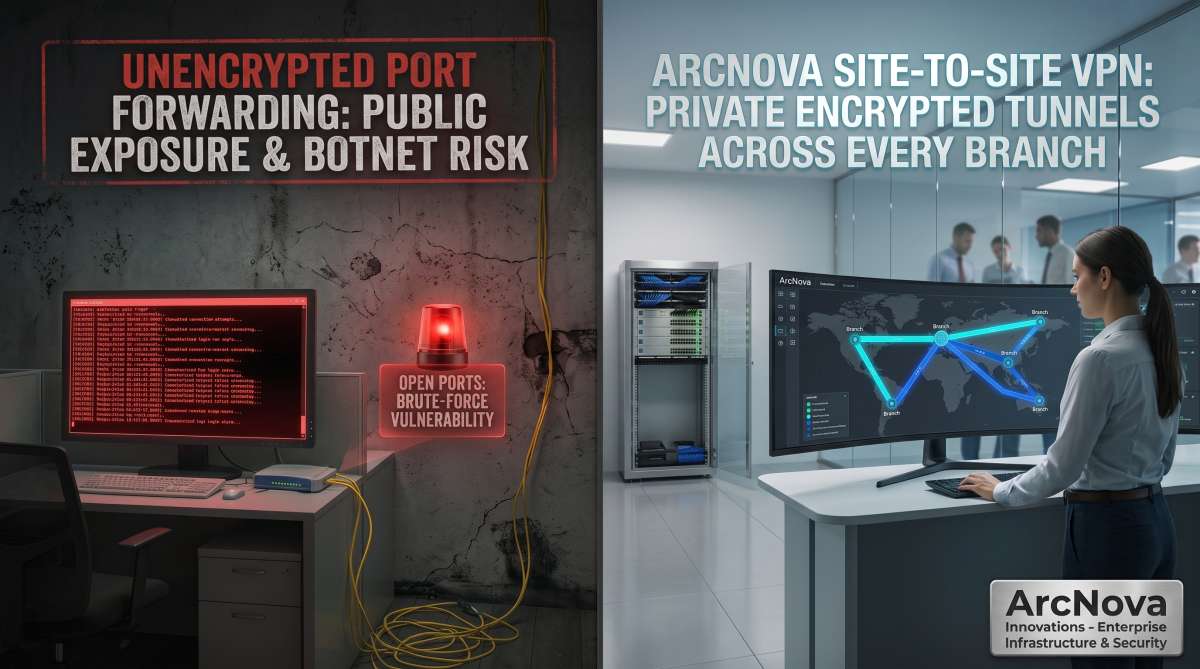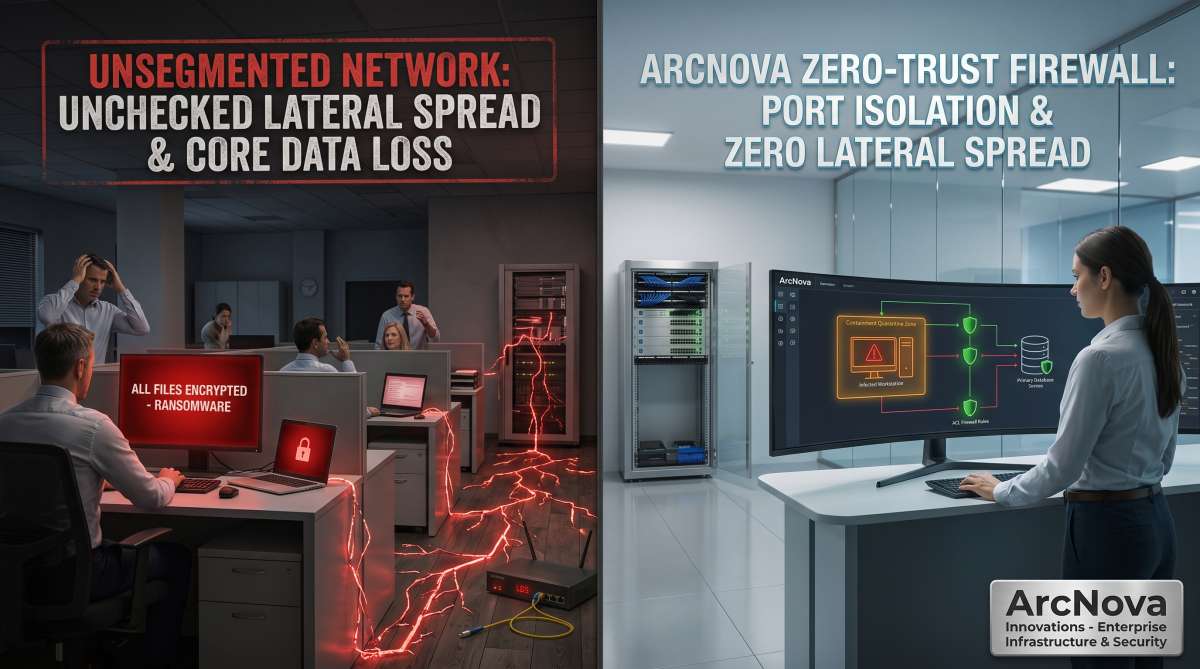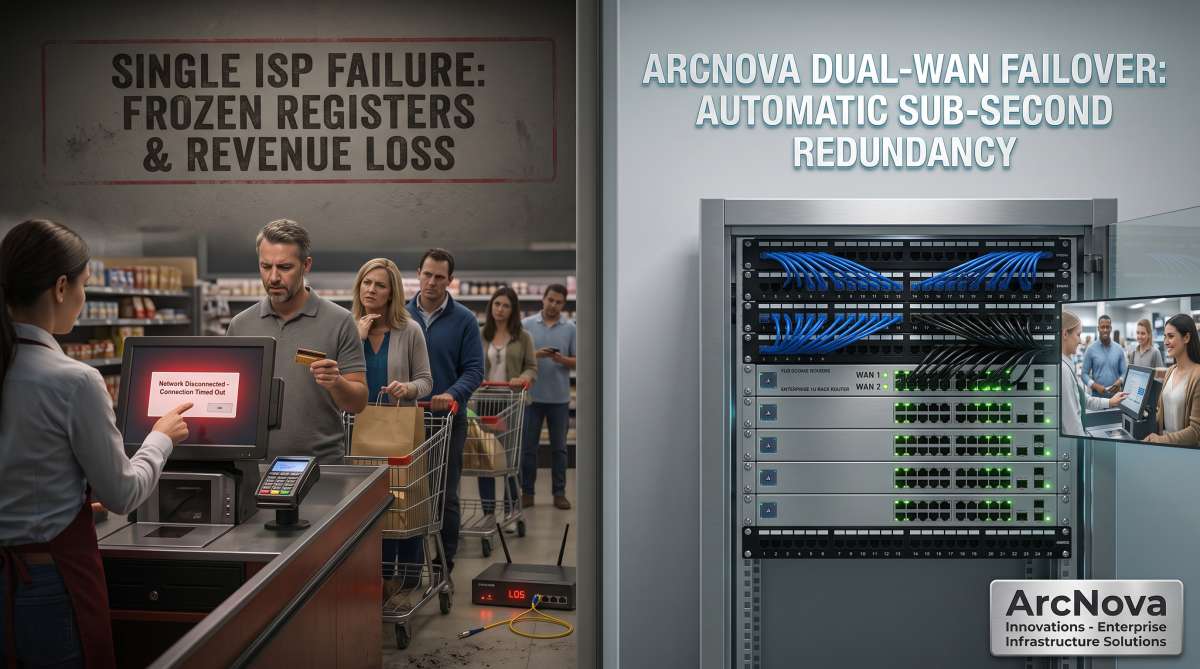
When a commercial facility, multi-counter retail pharmacy, clinic, or private school experiences intermittent internet drops or sluggish server access, leadership often assumes the Internet Service Provider (ISP) is at fault. They upgrade bandwidth packages at significant monthly expense, only to discover that checkout terminals still freeze, IP cameras still lag, and internal databases remain slow.
In most commercial environments, the root bottleneck is not the internet pipe—it is an unsegmented, flat local area network (LAN). When all hardware talks in the same broadcast domain without digital boundaries, operational traffic collides, slowing down essential business operations and leaving critical systems vulnerable.
Experiencing Network Freezes or Surveillance Latency?
ArcNova Innovations designs, deploys, and secures enterprise networks—complete with managed switching, Cat6 structured cabling, VLAN segmentation, and multi-SSID wireless setups.
Book an On-Site Network & Security Audit →What Is a Flat Network (And Why Does It Fail)?
In a standard flat network, every device connected to the switch or access point shares a single broadcast subnet (e.g., 192.168.1.0/24). That means your reception PC, customer smartphones on public Wi-Fi, IP security cameras streaming 5MP video, and mission-critical ERP database servers are all talking across the exact same digital hallway.
This architecture triggers three severe operational liabilities:
- Broadcast Storms & Packet Flooding: Every discovery request sent by an operating system is broadcast to every single node on the network. As your device count surpasses 40–50 terminals, packet collisions surge, causing high latency on billing terminals.
- Surveillance Bandwidth Congestion: High-definition NVR and IP surveillance streams generate continuous multi-megabit UDP traffic. On an unsegmented switch, this continuous video feed crowds out time-sensitive database queries and POS authorizations.
- Critical Security Exposure: If a customer or compromised guest smartphone connects to your office Wi-Fi on a flat subnet, basic network scanning tools allow them to see the IP addresses of your internal servers, POS terminals, and management consoles.
The Solution: Virtual Local Area Network (VLAN) Segmentation
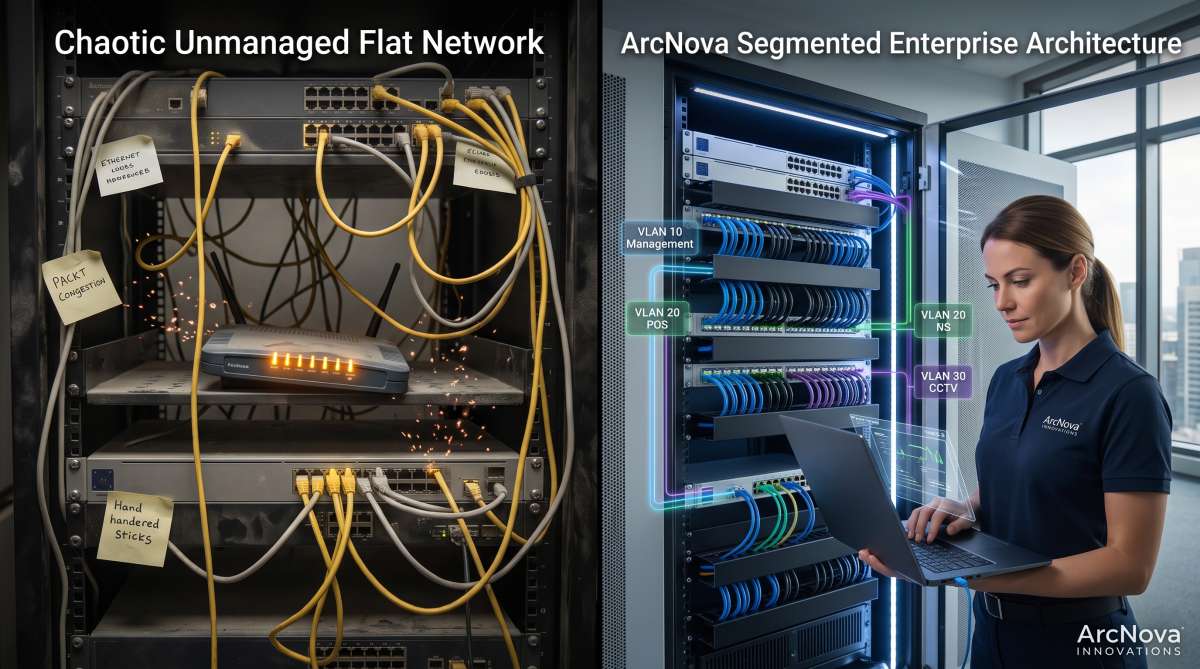
Enterprise network design uses managed switches and commercial routers (such as UniFi or MikroTik) to logically partition one physical network into isolated virtual subnet lanes. Hardware on different VLANs cannot communicate unless an explicit firewall rule permits it.
A typical enterprise segmentation model deployed by ArcNova looks like this:
- VLAN 10 (Management & Infrastructure): Dedicated solely to switches, routers, access point controllers, and uninterruptible power supplies (UPS). Blocked from general staff access.
- VLAN 20 (POS & Financial ERP): High-priority priority-queued traffic connecting checkout terminals directly to database hosts. Completely isolated from the internet and guest devices.
- VLAN 30 (IP CCTV Surveillance): High-bandwidth video streaming routed strictly between cameras and the Network Video Recorder (NVR), preventing video traffic from clogging front-office systems.
- VLAN 40 (Public / Guest Wi-Fi): Client isolation enabled with strict rate-limiting (e.g., 2 Mbps per user) and isolated DNS, preventing visitors from viewing any internal infrastructure.
Flat Unmanaged Networks vs. ArcNova Segmented Architecture
| Infrastructure Aspect | Unmanaged Flat Network | ArcNova Segmented Enterprise LAN |
|---|---|---|
| Device Isolation | None (Guests can probe internal servers) | Complete VLAN & Access Control List (ACL) isolation |
| Traffic Prioritization (QoS) | All devices fight equally for bandwidth | Quality-of-Service prioritizes ERP & POS billing queries |
| CCTV Stream Impact | Video packets choke administrative PCs | Surveillance traffic confined to dedicated VLAN subnet |
| Downtime Diagnostics | Blind troubleshooting; hard rebooting switches | Centralized controller with port-by-port traffic analytics |
Building for Predictable Business Continuity
Modern businesses cannot afford network hiccups during peak transaction hours. Structured Cat6 cabling, rack-mounted patch panels, enterprise managed switches, and proper VLAN routing transform a fragile IT environment into a dependable commercial utility.
Investing in reliable network architecture ensures your POS registers scan smoothly, surveillance feeds record without dropped frames, and internal business records remain secure behind hardware-enforced boundaries.
Upgrade Your Commercial Network Infrastructure
Speak directly with our network engineers to schedule a site survey or design a robust structured network plan.
Message Our Network Engineers on WhatsApp