As a commercial business, diagnostic lab network, or retail chain expands into multiple geographic locations, branches require continuous access to central digital assets. Point-of-sale registers need to post daily transactions, remote warehouse depots need to verify stock balances, and satellite clinics need to query central electronic medical records. However, connecting these distant sites often introduces significant security liabilities.
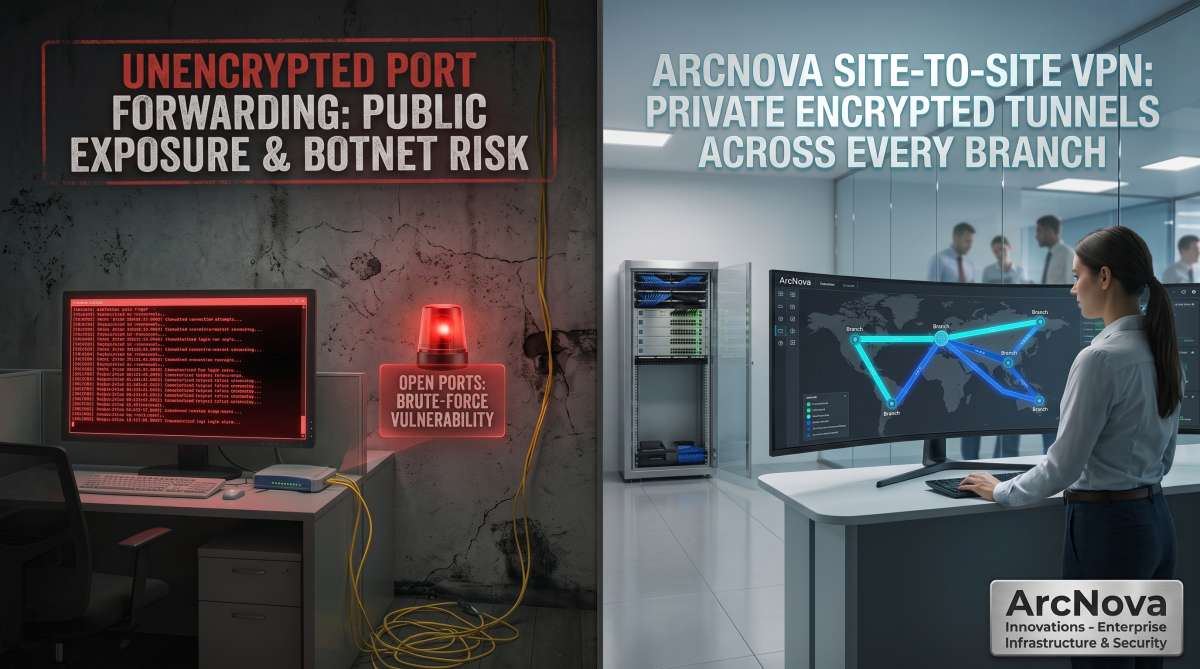
To establish connectivity quickly, unmanaged businesses often resort to dangerous shortcuts: configuring port forwarding on their central gateway, exposing database ports (such as MySQL port 3306 or Remote Desktop port 3389) directly to the public internet, or using outdated, unencrypted remote desktop tools. Within hours of opening an unencrypted port, automated global botnets scan and brute-force the entry point, leaving the central database vulnerable to ransomware injection and data theft.
Connecting regional facilities safely requires deploying Encrypted Site-to-Site VPN (Virtual Private Network) Tunnels—creating a private, hardware-accelerated communication pathway across public internet infrastructure without exposing a single open port to the outside world.
Connecting Remote Outlets or Warehouses to Your Head Office?
ArcNova Innovations engineers private, zero-trust Site-to-Site VPN tunnels and mesh networks using WireGuard, IPsec, and Tailscale—ensuring high throughput, robust encryption, and seamless database access.
Schedule a Multi-Branch Network Consultation →The 3 Critical Dangers of Port Forwarding Across Remote Branches
- Continuous Automated Port Scanning: Malicious crawlers scan every IPv4 address on the internet around the clock. The moment a standard database or management port is forwarded through a firewall, it becomes an active target for dictionary attacks, credential stuffing, and known zero-day exploits.
- Unencrypted Packet Interception: Standard internal protocols are designed for trusted local networks, not the open internet. Transmitting unencrypted queries over public lines exposes sensitive financial numbers, patient files, and proprietary sales data to eavesdropping.
- Carrier-Grade NAT (CGNAT) Connection Failures: Many commercial internet service providers do not issue public static IP addresses to branch offices, putting them behind Carrier-Grade NAT. Standard incoming port forwarding fails entirely in these setups, causing connection dropouts and unreliable access.
Modern Site-to-Site Tunneling Architectures
Enterprise site-to-site connectivity bridges entire local subnets together so that an authorized computer in Branch B can ping a server in Head Office using its internal IP address (e.g., 10.0.1.50), completely hidden from the public web. Depending on your operational topology, modern engineering relies on three proven technologies:
- WireGuard Site-to-Site: The modern standard for high-performance tunneling. Running on state-of-the-art cryptography (ChaCha20, Curve25519), WireGuard features a minimal codebase, exceptionally low overhead, and near-line-speed throughput—ideal for high-volume POS and database synchronization.
- IPsec / IKEv2 Hardware-Accelerated Tunnels: The long-standing enterprise workhorse, natively supported across industrial routers (such as MikroTik and UniFi). IPsec offloads cryptographic calculations to hardware chips, providing rock-solid stability for multi-gigabit connections between large permanent corporate sites.
- Zero-Trust Tailscale / WireGuard Mesh Networks: An ideal solution for branches operating behind strict CGNAT or dynamic mobile 4G/5G connections. Tailscale establishes direct peer-to-peer encrypted mesh tunnels using automated NAT-traversal, eliminating the requirement for expensive static public IPs at every single branch.
Unsecured Port Forwarding vs. ArcNova Encrypted Site-to-Site Architecture
| Interconnection Parameter | Unsecured Public Port Forwarding | ArcNova Encrypted Site-to-Site Tunnel |
|---|---|---|
| Public Attack Surface | High (Database/RDP ports open to global bots) | Zero (No listening ports visible to public scanners) |
| Data Security & Privacy | Vulnerable to man-in-the-middle sniffing | End-to-end ChaCha20 / AES-256 bit military-grade encryption |
| Handling ISP NAT / Dynamic IPs | Breaks frequently; requires static IPs everywhere | Seamless NAT traversal and auto-reconnecting endpoints |
| User Operational Experience | Manual logins, unstable third-party software | Always-on, transparent local subnet routing |
Transparent Network Integration for End Users
The true benchmark of professional network engineering is transparency. Branch employees should not have to manually launch desktop dialers or memorize complicated public IP addresses to do their jobs. In a properly configured Site-to-Site architecture, the network router handles the tunnel automatically in the background.
When a billing clerk at a satellite outlet opens their desktop terminal, the ERP connects instantly to the central server via local internal addressing—combining top-tier cryptographic defense with effortless day-to-day usability.
Unify Your Multi-Branch Network Securely
Speak directly with our enterprise network engineers to configure secure Site-to-Site VPN tunnels or private mesh connectivity across all your operating locations.
Message Our Network Engineering Team on WhatsApp