Modern commercial operations—whether a bustling private hospital, a multi-lane supermarket, or a regional corporate office—depend entirely on uninterrupted internet connectivity. Cloud-based ERP dashboards, point-of-sale credit card processing, digital diagnostic report distribution, and remote surveillance streaming all demand constant data transmission. Yet an alarming number of multi-million-rupee businesses run their entire digital operation over a single, unbacked residential or small-business broadband line.
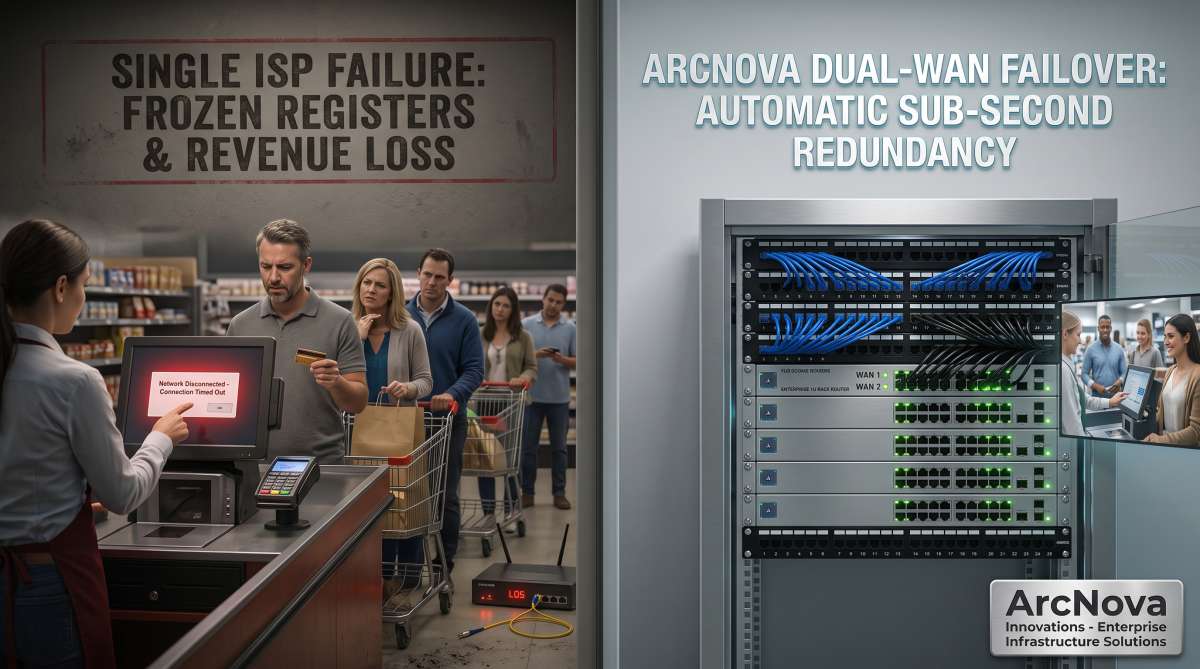
When nearby construction severs an underground optical fiber line, or an Internet Service Provider (ISP) suffers routine maintenance downtime, the entire facility grinds to an immediate halt. Cashiers cannot clear customer baskets, pharmacy staff cannot check real-time stock balances, and executive teams lose access to communication channels. Relying on staff to manually connect their smartphones via hotspot or manually swap Ethernet cords between routers wastes valuable operational minutes and introduces chaotic network conflicts.
Achieving true business continuity requires deploying Enterprise Dual-WAN Failover and Load Balancing managed by commercial routing hardware.
Is Internet Downtime Costing Your Business Money?
ArcNova Innovations designs and configures enterprise multi-WAN routing (utilizing MikroTik and UniFi gateways) with automated, sub-second failover across diverse fiber and wireless broadband links.
Schedule an Internet Redundancy & Gateway Audit →Failover vs. Load Balancing: What Is the Difference?
Enterprise dual-WAN architecture leverages two or more independent service providers simultaneously through two primary routing configurations:
- Automatic Failover (Active / Standby): Your primary high-speed fiber link handles all outbound and inbound operational traffic under normal conditions. The enterprise router continuously pings external watchdog targets (e.g., Cloudflare
1.1.1.1or Google8.8.8.8). The moment packet loss or total line disconnection is detected on WAN 1, the gateway shifts all network traffic to secondary backup WAN 2 within seconds—without requiring human intervention. - Multi-WAN Load Balancing (Active / Active): Both internet connections remain active simultaneously. The router distributes outgoing traffic dynamically across both pipes (e.g., PCC - Per Connection Classifier routing). This effectively pools your bandwidth, ensuring heavy CCTV cloud uploads do not compete with POS transactions and VoIP executive meetings.
The 3 Costly Traps of Single-ISP Dependence
- Unrecoverable Peak-Hour Sales Losses: In retail or restaurant environments, an internet outage during a peak Friday rush prevents card terminals and cloud POS from syncing. Customers abandon carts rather than waiting, resulting in permanent revenue loss.
- Manual Switchboard Panic: When the internet dies, employees scramble to reboot consumer modems, pull loose cords from one device to another, or attempt to connect company PCs to personal mobile hotspots, exposing internal company data to unmonitored consumer networks.
- False Redundancy (Same Physical Route): Many businesses subscribe to two different local internet providers, only to discover during an outage that both vendors purchase wholesale bandwidth from the same upstream telecom tower or run fiber optic cables through the exact same underground physical conduit.
Key Architectural Rules for True Enterprise Redundancy
An enterprise failover deployment protects your facility through engineered structural independence:
- Physical Medium Diversity: Primary and secondary WAN connections should utilize different physical transmission technologies (e.g., Primary: Dedicated Optical Fiber GPON; Secondary: High-Speed 4G/5G Enterprise Fixed-Wireless or Microwave Link). If an excavator digs up street cables, your wireless backup remains completely untouched.
- Policy-Based Routing (PBR): High-priority business traffic (such as POS transactions, hospital billing folios, and VoIP calls) is configured to automatically take precedence on the backup link, while non-essential bandwidth hogs (such as guest Wi-Fi and social media browsing) are temporarily throttled or blocked during failover states.
- Automated WAN Health Monitoring: Enterprise gateways monitor latency, packet loss, and jitter rather than merely checking physical link state. If an ISP line degrades to an unusable crawling state without going completely dark, the router intelligently migrates sessions to the clean connection.
- Seamless State Recovery (Failback): Once the primary optical link is fully restored and proven stable for a configured test period (e.g., 5 continuous minutes without dropped packets), the router smoothly migrates core traffic back to WAN 1 without disrupting live sessions.
Single Home-Grade Router vs. ArcNova Dual-WAN Enterprise Gateway
| Operational Metric | Single ISP / Consumer Router | ArcNova Dual-WAN Enterprise Gateway |
|---|---|---|
| Uptime Resilience | 0% during line cuts (Total facility shutdown) | 99.99% continuous business continuity |
| Failover Speed | 15–45 minutes of manual scrambling | Sub-second to 3 seconds automated switch |
| Bandwidth Utilization | Bottlenecked by single ISP connection | Aggregated active bandwidth via load balancing |
| Critical Traffic Priority | Guest YouTube streams choke register billing | QoS guarantees maximum priority for POS & ERP |
Converting Reliability into a Commercial Advantage
In high-transaction commercial facilities, network uptime translates directly into trust, reputation, and revenue. Customers remember the store that always processes cards smoothly, and medical professionals rely on the facility whose electronic health records never freeze.
Investing in a dedicated Dual-WAN gateway with automated load balancing transforms a fragile internet utility into a bulletproof commercial lifeline—allowing your staff to work with confidence regardless of local provider disruptions.
Eliminate Internet Outages Across Your Facilities Today
Speak directly with our enterprise network engineers to configure an automated Dual-WAN failover router and load balancing architecture tailored to your infrastructure.
Message Our Network Engineering Team on WhatsApp