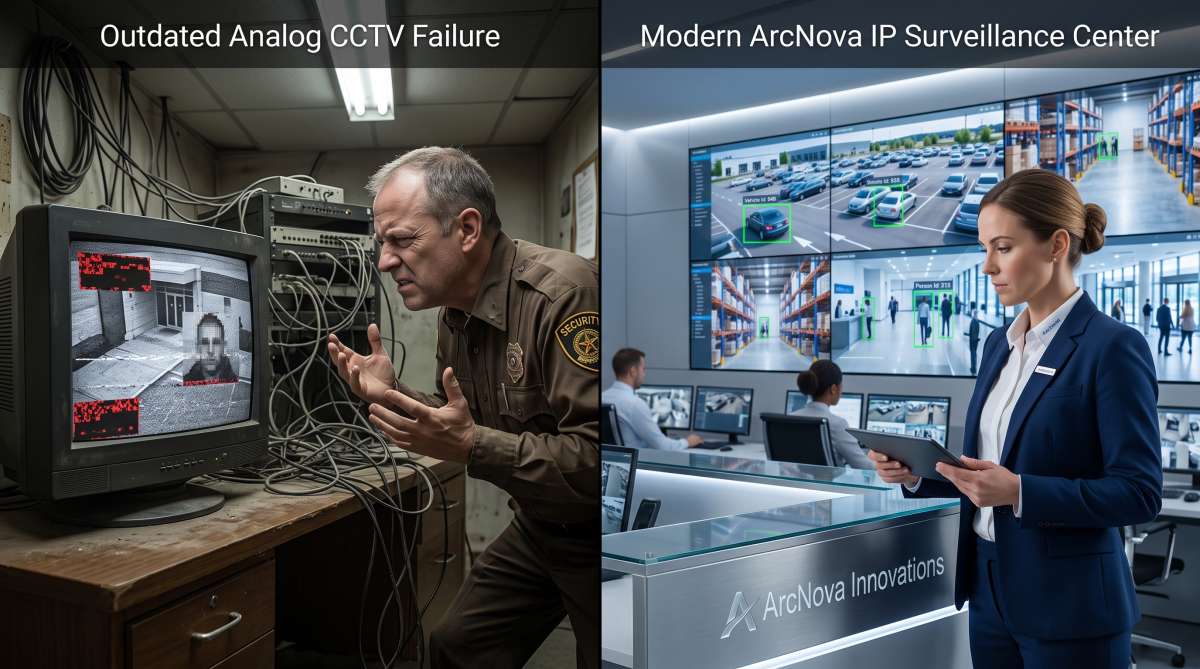
Physical security is the first line of defense for commercial facilities, medical centers, warehouses, and educational campuses. Yet many operations still rely on outdated analog coaxial CCTV cameras installed years ago. When an incident occurs—such as inventory shrinkage in a dispatch dock, an after-hours perimeter breach, or a checkout counter dispute—management inevitably faces the same problem: blurry, low-resolution footage where faces and license plates are unrecognizable, or worse, a dead hard drive that stopped recording weeks earlier without warning.
Security surveillance is not just about mounting plastic camera domes; it is about building a reliable digital evidence pipeline. Upgrading to an enterprise IP (Internet Protocol) surveillance network provides high-definition clarity, intelligent motion detection, centralized Network Video Recorder (NVR) redundancy, and real-time remote monitoring.
Planning a Facility Security Upgrade?
ArcNova Innovations designs, installs, and maintains enterprise IP surveillance systems featuring high-resolution POE cameras, multi-terabyte NVR storage arrays, and secure mobile access.
Request an On-Site Security Survey →The 3 Critical Liabilities of Legacy Analog CCTV
- Severe Resolution Limitations: Analog systems transmit video over coaxial cables (RG59) susceptible to electrical noise, signal degradation over distance, and fuzzy resolution that makes facial identification virtually impossible beyond a few meters.
- Cluttered Cabling & Power Inefficiencies: Analog setups require dual-lead siamese cabling—one for video and one for high-voltage DC power adapters—creating tangled wiring closets and elevated fire risk.
- Passive Recording Without Intelligent Alerts: Traditional DVRs simply write static video streams to disk. If a camera angle is obstructed, disconnected, or covered during a break-in, nobody notices until an operator manually checks the monitor days later.
Key Architectural Benefits of Enterprise IP Surveillance
Modern IP camera deployments connect over standard Ethernet (Cat6) network architecture to deliver complete visual situational awareness:
- Power over Ethernet (PoE) Simplicity: A single Cat6 network cable delivers both gigabit data transmission and operating power directly from a managed PoE switch, eliminating the need for separate electrical adapters at each camera mount.
- AI-Powered Smart Analytics: Modern IP cameras feature on-board neural chips capable of distinguishing between human movement, vehicles, and blowing foliage, dramatically reducing false alarm notifications and supporting instant target searches.
- Ultra-High Definition & Wide Dynamic Range (WDR): Ranging from 4MP to 4K resolutions with True WDR, IP cameras clearly capture details in high-contrast lighting, such as sunny parking lots, shaded entryways, and cash transaction counters.
- Isolated Network Security (VLAN Integration): Enterprise IP cameras are routed through dedicated surveillance VLANs, preventing streaming traffic from choking office internet bandwidth while keeping the video network air-gapped from unauthorized network probing.
Legacy Analog CCTV vs. ArcNova Enterprise IP Surveillance
| Surveillance Metric | Legacy Analog Coaxial Setup | ArcNova Enterprise IP Network |
|---|---|---|
| Video Clarity & Detail | Sub-HD or 1080p with analog signal noise | Crystal-clear 4MP, 5MP, and 4K digital streams |
| Cabling Architecture | Bulky Siamese coaxial + separate power adapters | Single Cat6 structured cable with PoE switch power |
| Search & Playback Speed | Hours of manual scrubbing through timelines | Instant smart-event filtering by human or vehicle |
| Storage Redundancy | Single vulnerable internal DVR drive | Enterprise multi-bay NVRs with RAID disk protection |
Building a Reliable Commercial Surveillance Perimeter
Surveillance cameras are only as dependable as the network infrastructure supporting them. High-bitrate cameras require enterprise-grade PoE switching, clean structured cable runs, industrial-grade hard drives rated for 24/7 continuous write cycles, and battery-backed power units to ensure uninterrupted recording during electrical cuts.
Investing in a structured IP security deployment ensures your premises, inventory, and staff are monitored continuously with clear, verifiable digital records.
Secure Your Commercial Facility Today
Contact our systems engineers to design an enterprise IP camera layout or audit your existing surveillance network.
Consult with Our Security Specialists on WhatsApp