In medical software, data accessibility must always be balanced against strict patient confidentiality. When a healthcare facility migrates from physical paper files to Electronic Medical Records (EMR), the primary goal is often operational convenience: ensuring that any staff member can quickly pull up patient details. However, when software grants administrative clerks, receptionists, and billing staff identical privileges to attending physicians, the facility exposes itself to critical data leaks and clinical tampering.
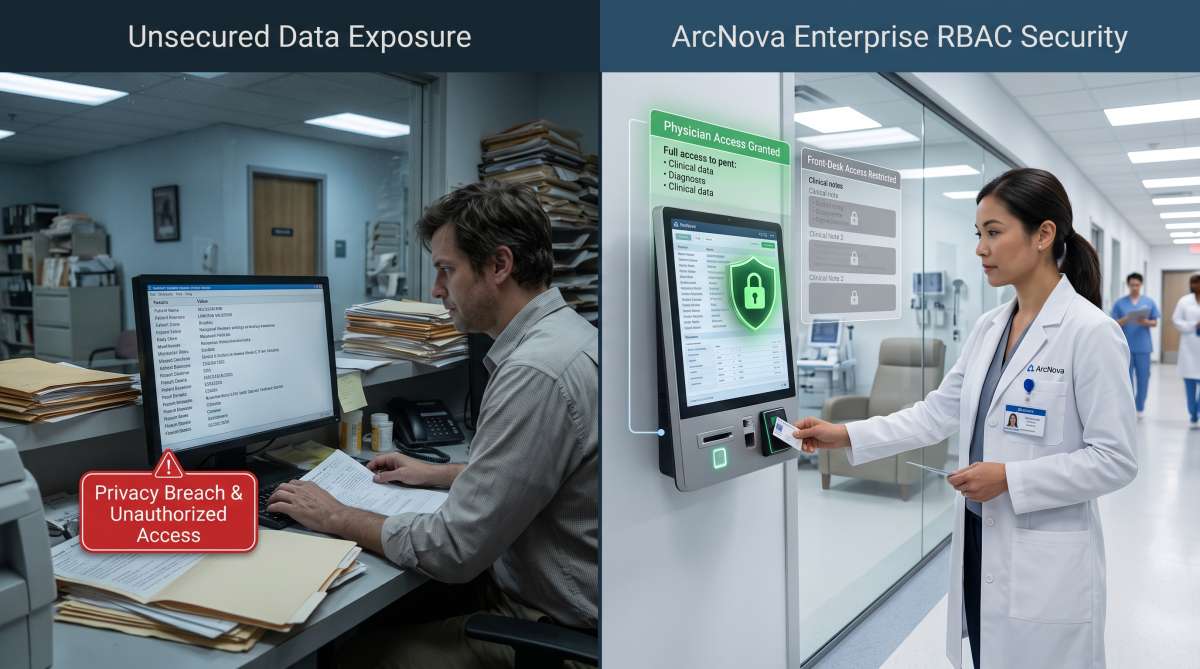
A front-desk cashier booking an outpatient token needs to know a patient's name, phone number, and billing dues. They do not need—and should never see—a patient's psychiatric consultation notes, infectious disease serology, or confidential surgical histories. Allowing blanket database access violates patient trust and exposes healthcare providers to severe liability.
Protecting modern healthcare records requires implementing strict Role-Based Access Control (RBAC)—enforcing least-privilege security policies directly at the database and application interface levels.
Auditing Your Clinic or Hospital EMR Security?
ArcNova Innovations builds HIPAA-aligned, secure healthcare software featuring multi-tier RBAC, automated audit trails, and encrypted database architecture.
Schedule an EMR Security & Architecture Audit →The 3 Core Security Risks of Unsegmented Medical Data
- Internal Patient Privacy Breaches: Without role boundaries, any hospital employee can look up high-profile individuals, neighbors, or colleagues out of curiosity, exposing sensitive diagnostic records.
- Unauthorized Record Mutation & Erasure: When receptionists or general operators hold administrative database rights, they can alter clinical notes, adjust billed charges after hours, or delete historical visits to conceal billing discrepancies.
- Ransomware & Credential Theft Vulnerability: If a front-desk computer running basic internet tasks gets infected with malware, and that workstation uses a generic "Master Admin" software login, the malware gains complete access to your entire patient database.
Architectural Breakdown of Enterprise RBAC in Healthcare
Role-Based Access Control enforces the principle of least privilege by segmenting application screens and database read/write permissions by organizational job function:
- Front-Desk Reception Role: Permitted to register demographics, generate queue tokens, and print visit receipts. Completely blocked from viewing diagnostic lab values, clinical doctor notes, and past surgical summaries.
- Attending Physician Role: Full read/write access to patient clinical vitals, diagnostic histories, e-prescriptions, and progress notes. Blocked from modifying hospital accounting ledgers, cashier shift drawers, or system user settings.
- Clinical Laboratory Role: Permitted to access sample accessioning, input analyzer values, and generate lab reports for authorized test orders. Blocked from viewing general inpatient doctor charting or modifying finalized billing totals.
- Hospital Administrator Role: Permitted to view anonymized operational reports, staff shift audits, and macro revenue analytics. Clinical records remain accessible only under documented emergency audit conditions.
Generic Open EMR vs. ArcNova Role-Based Security
| Security Metric | Generic Unrestricted Software | ArcNova Granular RBAC Architecture |
|---|---|---|
| User Privileges | Shared "Admin" accounts used by multiple staff | Individual user logins with granular permission matrices |
| Diagnostic Note Visibility | Visible to cashiers and non-clinical staff | Restricted exclusively to treating medical providers |
| Audit Trail Tracking | None (Impossible to see who viewed a chart) | Every read, print, edit, or export is timestamped with user ID |
| Record Mutability | Signed notes can be overwritten or deleted | Immutable clinical logs; modifications require addendums |
The Role of Immutable Audit Logging
RBAC is incomplete without continuous audit logging. An enterprise clinical application records every interaction: who opened a patient's chart, what workstation IP address sent the request, whether the record was modified, and if it was printed or exported as a PDF.
When staff know that every access event is permanently recorded in a tamper-resistant audit log, curiosity-driven unauthorized lookups drop to zero, safeguarding clinical reputation and patient trust.
Harden Your Healthcare System's Data Security
Speak directly with our healthcare software engineers to implement role-based access controls and encrypted database architecture across your facility.
Message Our Health-Tech Team on WhatsApp