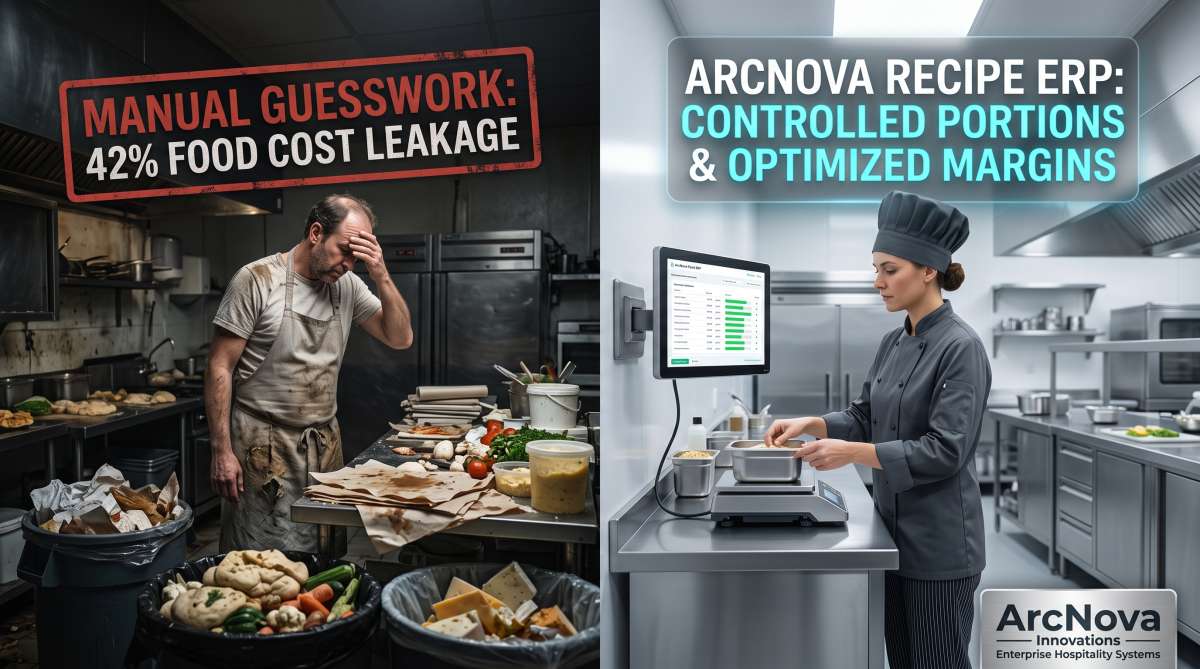
In food service and restaurant management, profit margins are won or lost in the prep kitchen. While dining room registers may show booming gross sales, restaurant owners often discover at month-end that net profit has vanished into thin air. When auditing operational expenses, food cost percentage—which should ideally hover between 28% and 35%—has crept upward to 42% or higher.
The root cause is rarely supplier inflation alone. In most unautomated food operations, raw material tracking relies on guesswork: counting bulk bags of flour, blocks of cheese, and meat cartons at the end of the month and comparing that against sales totals. This leaves kitchen operations completely blind to the three biggest drains on food profitability: over-portioning, kitchen waste, and internal raw ingredient pilferage.
Stopping food margin erosion requires implementing Recipe-Based Inventory Control (Bill of Materials) integrated directly into your Point of Sale (POS) and production workflow.
Take Control of Your Kitchen Food Costs & Recipes
ArcNova’s Food Service & Restaurant ERP features multi-level recipe mapping, automated gram-level sub-ingredient depletion, and live variance tracking between theoretical and actual food costs.
Schedule an Interactive Restaurant ERP Demo →The 3 Silent Profit Killers in Commercial Kitchens
- Uncontrolled Over-Portioning: If a recipe calls for 150 grams of mozzarella cheese on a large pizza, but line cooks consistently use 190 grams without measuring, that extra 40 grams goes unnoticed per order. Across 2,000 pizzas a month, the kitchen gives away 80 kilograms of premium cheese for free.
- Untracked Prep Spoilage & Burns: When a batch of sauce burns or prep cooks trim meat inefficiently, unrecorded losses occur. Without a digital waste log, staff discard spoiled raw materials into the trash without accounting for lost value.
- Ingredient Shrinkage & Pilferage: High-cost raw inventory—such as prime beef cuts, dairy, specialty cheeses, and cooking oils—is vulnerable to theft when raw bulk stock is not balanced against rung-up sales at the register.
The Architecture of Automated Recipe Management
An enterprise hospitality platform monitors inventory down to sub-ingredient units by establishing automated digital recipe linkages:
- Multi-Level Bill of Materials (BOM): Every menu item is broken down into exact sub-components. A single burger order links to an itemized inventory recipe: 1 bun, 180g ground beef, 1 cheddar slice, 20g signature sauce, and 2g seasoning.
- Automated Real-Time Depletion: The exact millisecond a cashier rings up a menu item—or an order is completed on a Kitchen Display System (KDS)—the system automatically deducts the precise quantity of raw ingredients from central and line stores.
- Theoretical vs. Actual Cost Analysis: At the close of each shift, the ERP calculates Theoretical Food Cost (what should have been used based on actual register sales) and compares it against Actual Physical Count. Variances beyond acceptable yield tolerances trigger immediate alerts for management review.
- Sub-Recipe Batch Production: For bakeries and central production kitchens preparing large batches of dough, marinades, or sauces, the system records bulk raw ingredient inputs and yields finished stock items ready for distribution to satellite branches.
Manual Kitchen Guesswork vs. ArcNova Recipe Inventory Engine
| Operational Metric | Manual Month-End Counts | ArcNova Recipe-Based ERP |
|---|---|---|
| Stock Depletion Tracking | Calculated weeks later from bulk invoices | Real-time gram-level deduction per transaction |
| Portion Control Visibility | None (Over-portioning goes undetected) | Identified immediately via yield variance reports |
| Food Waste Tracking | Discarded food unrecorded in trash bins | Mandatory digital spoilage logging with user IDs |
| Branch Reordering Accuracy | Subjective guesses leading to stockouts | Data-driven procurement triggers based on run-rates |
Protecting Your Bottom Line While Scaling
Consistency is the hallmark of any successful franchise or multi-unit hospitality brand. Customers expect the exact same flavor profile, quality, and portion size whether they visit your flagship location or a newly opened satellite branch.
Standardizing recipes inside an integrated management system enforces strict kitchen compliance, eliminates raw material theft, and equips food service operators with the operational discipline required to protect margins and scale profitably.
Stop Food Cost Leakage Across Your Kitchens
Speak directly with our hospitality technology engineers to set up automated recipe tracking and raw ingredient inventory control for your business.
Message Our Food-Tech Team on WhatsApp