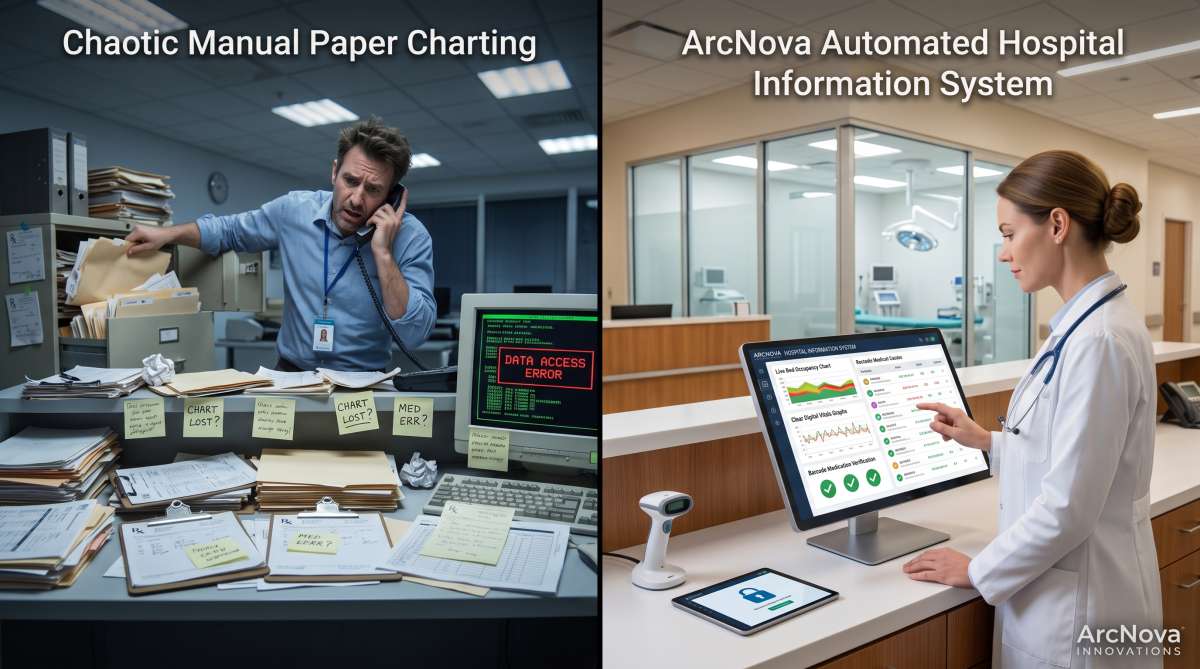
Modern healthcare facilities cannot afford operational disconnects. In a high-volume medical center, a patient’s journey touches multiple independent touchpoints: the outpatient token desk, physician consultation room, diagnostic laboratory, ultrasound department, inpatient ward, and in-house pharmacy. When these departments operate on isolated paper records or disconnected billing computers, the patient experience suffers and critical administrative oversight collapses.
Handwritten doctor notes get misinterpreted at the pharmacy counter, diagnostic test results arrive late to bedside physicians, and admitted patients frequently receive unbilled medications or procedures. The operational overhead required to manually reconcile patient charts ties up medical staff in clerical administration rather than active patient care.
An enterprise-grade Hospital Information System (HIS) connects clinical, administrative, and inventory workflows into a unified digital ecosystem.
Modernizing Your Clinic or Hospital Workflows?
ArcNova Innovations designs customized Hospital Information Systems (HIS) and Electronic Medical Record (EMR) portals engineered for high patient volume, seamless pharmacy linking, and real-time bed management.
Request an On-Site Hospital Software Consultation →The 3 Core Breakdowns of Paper-Driven Healthcare Facilities
- Prescription & Medication Dispensing Errors: Deciphering illegible physician handwriting at the pharmacy desk delays medication distribution and increases the risk of incorrect dosage dispensing.
- Inpatient Billing Leakage: In multi-day hospital admissions, disposable consumables, nursing procedures, and specialized bedside medications administered after midnight frequently escape manual charting, costing facilities 5% to 15% of their inpatient revenue.
- Fragmented Diagnostic History: When a physician sees a recurring patient, reviewing previous blood panels, radiological films, or chronic medication history requires manually hunting through physical archive rooms or relying on the patient’s own paper folder.
Core Functional Architecture of ArcNova Healthcare Systems
A resilient clinical management system connects four vital departments through a centralized patient Master Medical Record (MR Number):
- Centralized Token & OPD Management: Generates instant digital queue tokens and assigns patients to consulting rooms, balancing doctor consultation loads and tracking real-time waiting times.
- Digital E-Prescriptions & Clinical Notes: Doctors select standard dosages and diagnostic requests through intuitive dropdowns, automatically printing structured digital prescriptions and routing drug requests directly to the hospital pharmacy.
- Connected Inpatient & Nursing Station Portals: Bed allocation, vitals monitoring, doctor round notes, and administered medications are entered on ward terminals, instantly updating the patient's itemized financial folio in real time.
- Integrated Pharmacy & Inventory Depletion: Medication is dispensed by scanning barcodes directly against the digital prescription, preventing dispensing errors and triggering automated inventory re-order alerts when stock levels drop.
Traditional Paper Registers vs. ArcNova Hospital Information System
| Hospital Function | Paper Charts & Manual Registers | ArcNova Integrated HIS Platform |
|---|---|---|
| Patient Registration | Slow manual ledger entries; duplicate files | Instant MR Number token generation with visit history |
| Discharge Billing | Hours spent collecting manual chits across wards | Instant, one-click itemized checkout with zero billing leakage |
| Pharmacy Dispensing | Prone to handwriting transcription mistakes | Barcode-verified direct electronic prescription matching |
| Data Security & Records | Vulnerable to physical loss, misfiling, and water/pest damage | Encrypted role-based access with automated database snapshots |
Clinical Quality Meets Administrative Efficiency
Deploying an integrated hospital management system does not just organize financial ledgers; it elevates the standard of patient care. When medical personnel spend less time logging manual chits and sorting paper folders, they dedicate their full attention to patient recovery and clinical precision.
With centralized operational data, hospital directors gain clear visibility into bed occupancy rates, department revenues, doctor case numbers, and medicine stock velocity—empowering clinical leadership to make data-backed administrative decisions.
Transform Your Healthcare Facility’s Operations
Connect with our medical software engineering team to schedule a custom walkthrough of our Hospital Information System.
Message Our Healthcare Solutions Team on WhatsApp