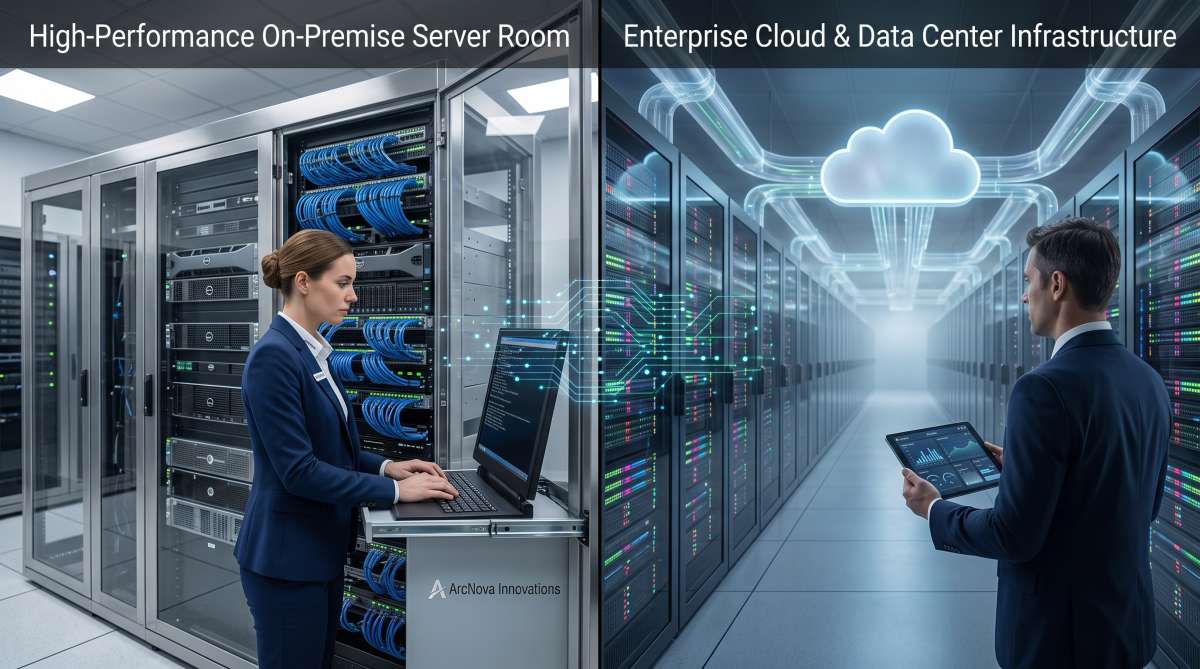
When leadership decides to deploy a new Enterprise Resource Planning (ERP) platform, hospital management system, or centralized accounting database, the first major infrastructure debate is almost always the same: Should we host this in the cloud or keep it on a dedicated physical server in our own office?
The tech industry frequently markets pure cloud hosting as the only modern choice. However, real-world business operations often face practical hurdles: unexpected cloud consumption bills, recurring monthly software fees, and—most critically—unpredictable local internet connections that can bring checkout lanes and diagnostic counters to a halt during an outage.
A successful IT deployment requires understanding the real-world trade-offs between Public Cloud, On-Premise Infrastructure, and practical Hybrid Architectures.
Planning a Server Deployment or Database Migration?
ArcNova Innovations designs, deploys, and manages robust server environments—from containerized local micro-servers to scalable multi-region cloud architectures.
Schedule a Server Architecture Consultation →1. On-Premise Infrastructure: High Control, Zero Latency
An on-premise setup places physical rack servers directly inside your building or central facility. It remains a reliable choice for hospitals, retail supermarkets, and production plants where immediate speed and offline availability are critical.
- Complete Offline Resilience: If your neighborhood internet provider suffers an optical fiber cut, your cashiers continue scanning barcodes, lab technicians continue printing reports, and internal teams continue working across the local gigabit LAN.
- Zero Recurring Subscription Shocks: Once high-grade server hardware is purchased and depreciated, your operational computing cost drops to electricity and routine maintenance.
- The Trade-Off: You must maintain physical hardware security, provide uninterrupted battery and generator power (UPS), and configure automated offsite backup routines to guard against hardware wear or site damage.
2. Cloud Hosting: Rapid Scalability, Accessible Anywhere
Cloud infrastructure provisions virtual computing instances (such as Virtual Private Servers or containerized clusters) hosted inside high-tier data centers. This works well for remote teams, e-commerce storefronts, and decentralized sales teams.
- Accessible Everywhere: Regional branches, remote executives, and mobile agents can log into your central ERP portal from any web browser without maintaining private VPN hardware.
- Enterprise Physical Redundancy: Tier-3 cloud data centers provide industrial diesel generators, multiple internet backbone connections, and built-in hardware fault tolerance.
- The Trade-Off: Total reliance on active internet connectivity. If your facility's local broadband goes down, all work on a pure cloud ERP stops until the line is restored. Monthly recurring costs also compound as storage and memory usage grow.
Side-by-Side Architectural Comparison
| Factor | On-Premise Local Server | Public Cloud Infrastructure | ArcNova Hybrid Model |
|---|---|---|---|
| Internet Dependency | Zero (Works locally 100%) | Critical (No internet = No work) | Local continuity + Cloud sync |
| Capital Cost (CapEx) | Higher upfront hardware purchase | Low upfront; high monthly OpEx | Balanced cost profile |
| Disaster Recovery | Requires explicit offsite routines | Automated multi-zone snapshots | Automated air-gapped snapshots |
| Data Latency | Ultra-fast (<1ms local LAN ping) | 30ms–150ms depending on routing | Sub-millisecond local caching |
The Smarter Alternative: The ArcNova Hybrid Strategy
For most growing businesses, the most resilient setup is neither purely cloud nor entirely isolated on-premise—it is a hybrid architecture:
- Local High-Availability Node: An on-site micro-server runs the primary operational database for day-to-day transactions (billing counters, barcode readers, lab machines) at sub-millisecond local network speeds, unaffected by internet interruptions.
- Automated Cloud Mirror: The local node quietly synchronizes encrypted transactional delta logs to a secure cloud server at scheduled intervals or whenever internet connectivity is active.
- Offsite Accessibility & Recovery: Business owners view consolidated branch reports online from anywhere in the world, while enjoying a completely automated, offsite disaster recovery mirror if local hardware ever fails.
Build the Right Server Foundation for Your Enterprise
Speak directly with our systems engineers to determine whether on-premise, cloud, or hybrid architecture best matches your budget and operational needs.
Message Our Server Architects on WhatsApp