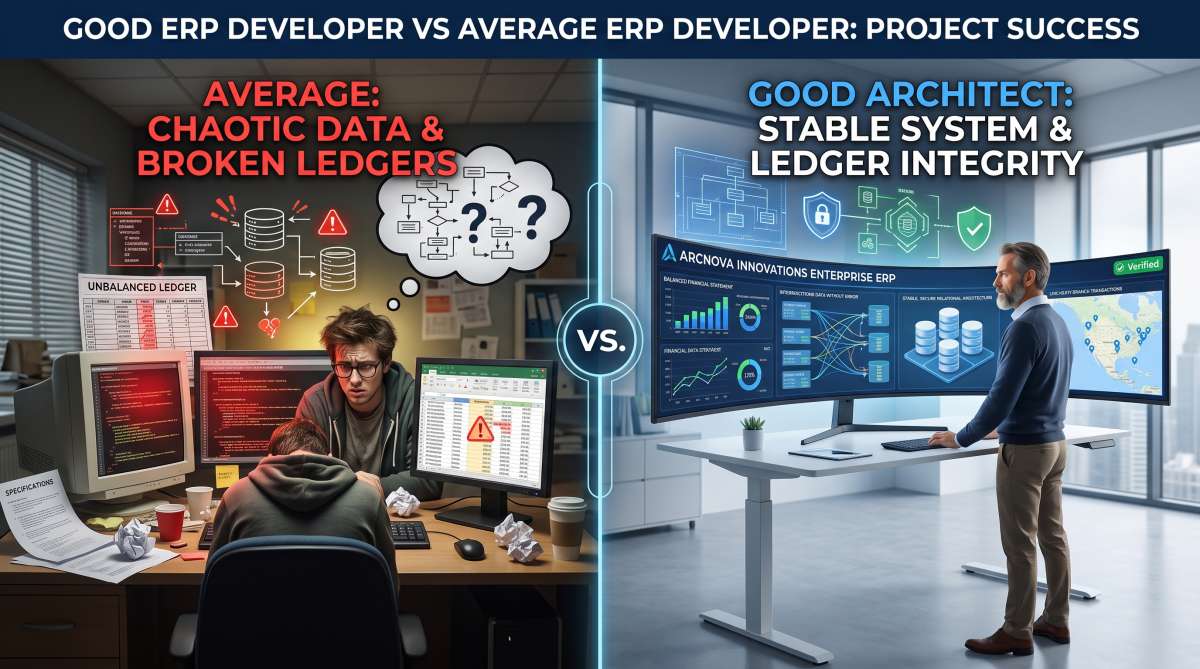
Enterprise Resource Planning (ERP) systems are the most unforgiving software environments in the technology industry. Unlike standard web applications or consumer platforms where edge-case data issues result in minor UI bugs, an unhandled transaction in an ERP corrupts financial ledgers, creates inventory ghost counts, and brings physical supply chains to a standstill.
Most failed ERP implementations do not fail because of slow frameworks or poor UI templates; they fail because companies hire average programmers when they actually need domain-driven ERP architects.
Building or Modernizing an Enterprise ERP?
ArcNova Innovations designs secure, battle-tested ERP systems for retail chains, healthcare networks, and distribution hubs—engineered for high-volume transactions with zero ledger drift.
Consult with Our Senior ERP Engineers →1. Understanding Database Architecture: CRUD vs. Financial Integrity
An average developer views an ERP as a collection of basic Create, Read, Update, and Delete (CRUD) forms. If a user edits an invoice, the average developer simply updates the row in the database:
UPDATE invoices SET total_amount = 500 WHERE invoice_id = 101;A senior ERP engineer understands that financial data must be immutable. You never mutate historic transactional rows. Instead, a good ERP architect implements an immutable double-entry journal system with audit trails, debit/credit balancing constraints, and compensating transactions (credit notes, reversal journals) so that every single cent is mathematically traceable back to its origin timestamp.
2. Concurrency & Race Conditions
In high-frequency retail POS, lab booking, or warehouse dispatch environments, multiple terminals read and write to the same stock items simultaneously:
- The Average Approach: Reads the inventory count, subtracts 1 in application memory, and writes it back. Under heavy load, two cashiers selling the last remaining unit will both succeed—causing negative stock, overselling, and inventory drift.
- The Senior ERP Approach: Implements pessimistic locking, database row-level locks (
SELECT ... FOR UPDATE), or transactional atomic operations. They design for high concurrency so that race conditions are structurally impossible at the engine level.
3. Business Domain Empathy
The starkest difference between an average developer and an expert ERP engineer is not their syntax—it is their business acumen:
- Average developers wait for explicit functional specifications. If an accountant requests an "expense module," they provide an input form that stores text and an amount, ignoring tax deduction categories, cash-flow impact, and vendor balances.
- Good ERP developers understand accounting and operational realities natively. They ask: "How does this affect your chart of accounts? What happens during a partial return? How should VAT/Sales Tax round off across bulk line items?" They build software that speaks the CFO's and operations manager's language out of the box.
Side-by-Side Comparison
| Engineering Metric | Average Developer | Good / Elite ERP Architect |
|---|---|---|
| Data Integrity | Allows manual record overwrites & deletions | Immutable ledgers, reversal vouchers, full audit log |
| Security & RBAC | Hardcoded user roles (Admin vs. User) | Granular role-based permissions at module & action level |
| System Performance | Slows to a crawl after 50k transactions | Optimized indices, query profiling, archiving pipelines |
| Offline Resilience | Entire operations freeze when the internet drops | Local node fallbacks with background data reconciliation |
Why the Engineering Standard Determines Your ROI
An average developer may deliver a project faster in month one by cutting architectural corners. However, by month six, when customer traffic spikes, unindexed queries cause database timeouts, cash shifts do not balance, and reports produce phantom figures that require costly manual reconciliations.
Investing in senior ERP engineering ensures that as your branches, warehouses, and transaction volumes multiply by 10x, the underlying foundation remains resilient, secure, and accurate.
Need an Enterprise-Grade System Built Right?
Speak directly with our solutions architects about custom ERP development, migrations, or database performance optimization.
Message Our Engineering Team on WhatsApp